Alcohol & Mental Health: Short-term relief, long-term cost

Drinking may feel like it helps you relax or cope, but it can increase anxiety and depression, disrupt brain function, and harm emotional well‑being. This site turns a research essay into an interactive guide for students.

Audience: college students • Purpose: inform, persuade, and activate healthier choices

WHY IT MATTERS

A quick overview of the core claims your essay defends.

Anxiety & Depression

Alcohol acts as a depressant; regular or heavy use is linked with higher rates of anxious and depressive symptoms.

Brain Function

Disrupts communication pathways, impairs memory (hippocampus), decision‑making, and emotion regulation.

Emotional Well-Being

Mood swings, irritability, guilt/shame, isolation, and relationship strain can follow ongoing use.

Hope & Recovery

Recovery works. Therapy, medications, and support groups help millions—earlier is easier.

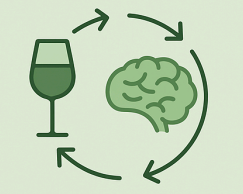
THE “FEEL BETTER” CYCLE

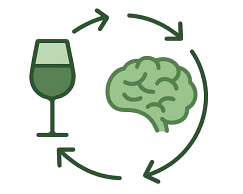
Drinking can briefly elevate dopamine and create calm. When it wears off, serotonin dips → anxiety or low mood. The brain learns a quick fix and repeats it.

Drink → Relief → Crash → Repeat

1. Dopamine spike: feels good now

2. Serotonin dip: anxious/low later

3. Brain learns the quick fix

4. Habit strengthens without new coping

Tip: Interrupt the loop with a tiny alternate behavior you can repeat.

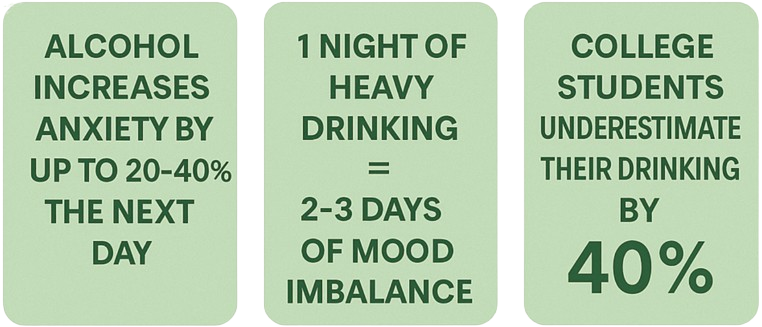
ALCOHOL
INCREASES
ANXIETY BY
UP TO 20-40%
THE NEXT DAY

1 NIGHT OF HEAVY DRINKING
=
2-3 DAYS OF MOOD IMBALANCE

COLLEGE
STUDENTS
UNDERESTIMATE
THEIR DRINKING
BY
40%

Inside the brain

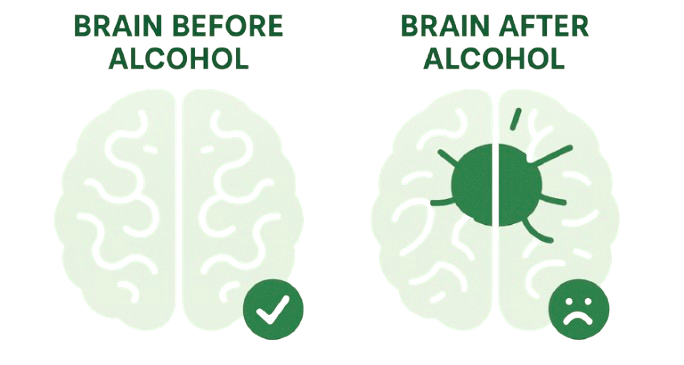
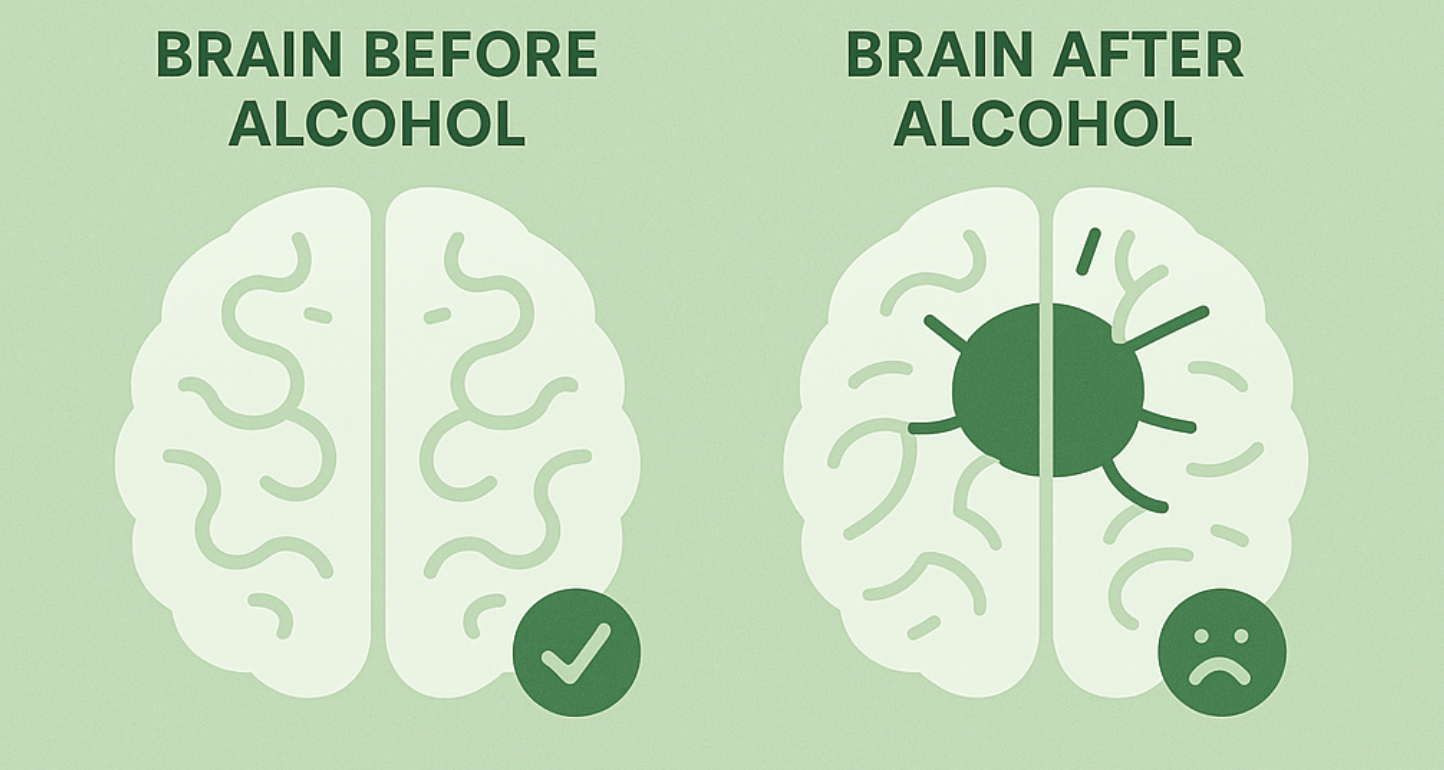
Alcohol interferes with neural communication and can shrink or damage regions key for memory and self‑control. Adolescent brains are especially vulnerable while pathways are still wiring up.

Hippocampus

Memory & learning

Prefrontal cortex

Judgment & impulse control

Emotion circuits

Mood regulation

Connectivity

Quality of neural wiring

Memory

Hippocampus sensitive to alcohol; impacts learning.

Judgment

Prefrontal control reduced → risky choices.

Emotion

Mood regulation disrupted; rebound anxiety.

Connectivity

Adolescent wiring vulnerable during development.

Emotions & social life

What feels like liquid confidence can lead to mood swings, irritability, guilt or shame, isolation, and relationship strain—making stress harder to manage without alcohol.

Tip: Swap in coping skills—walk with a friend, 10‑minute mindfulness, or a journal sprint. Small repetitions rewire habits.

Myths vs. Facts About Alcohol & Mental Health

Quick comparisons like these make the information easier to skim and remember.

Myth: “Alcohol helps me sleep.”

Fact: It knocks you out, but ruins deep, restorative sleep.

Myth: “Drinking calms my anxiety.”

Fact: It numbs anxiety short-term but often increases it the next morning.

Myth: “If I don’t drink every day, I don’t have a problem.”

Fact: Patterns, blackouts, guilt, and next-day anxiety matter more than frequency.

Myth: “Everyone else drinks more than me.”

Fact: Most people overestimate how much their peers actually drink.

How to Help a Friend

You don’t have to fix anyone’s situation. Just being there can make a big difference.

Sources

Crawford, Chris. “Emotional Effects of Alcohol.” The Recovery Village, The Recovery Village, 22 Mar. 2018,

Hanley Foundation. “Alcohol’s Effect on an Undeveloped Brain.” Hanley Foundation, 23 Jan. 2024,

hanleyfoundation.org/prevention-blogs/alcohols-effect-on-an-undeveloped-brain. Accessed 10 Nov. 2025.

National Institute on Alcohol Abuse and Alcoholism. “Alcohol and the Brain: An Overview.” National Institute on Alcohol Abuse and Alcoholism, 2022

“Treatment for Alcohol Problems: Finding and Getting Help.” Nih.gov, Feb. 2025,

Schuckit, Marc A. “Alcohol, Anxiety, and Depressive Disorders.” Alcohol Health and ResearchWorld,vol20,no.2,2024,p.81,pmc.
ncbi.nlm.nih.gov/articles/PMC6876499/